Planting with chopsticks
Published Sep 1, 2026 · 7 min read
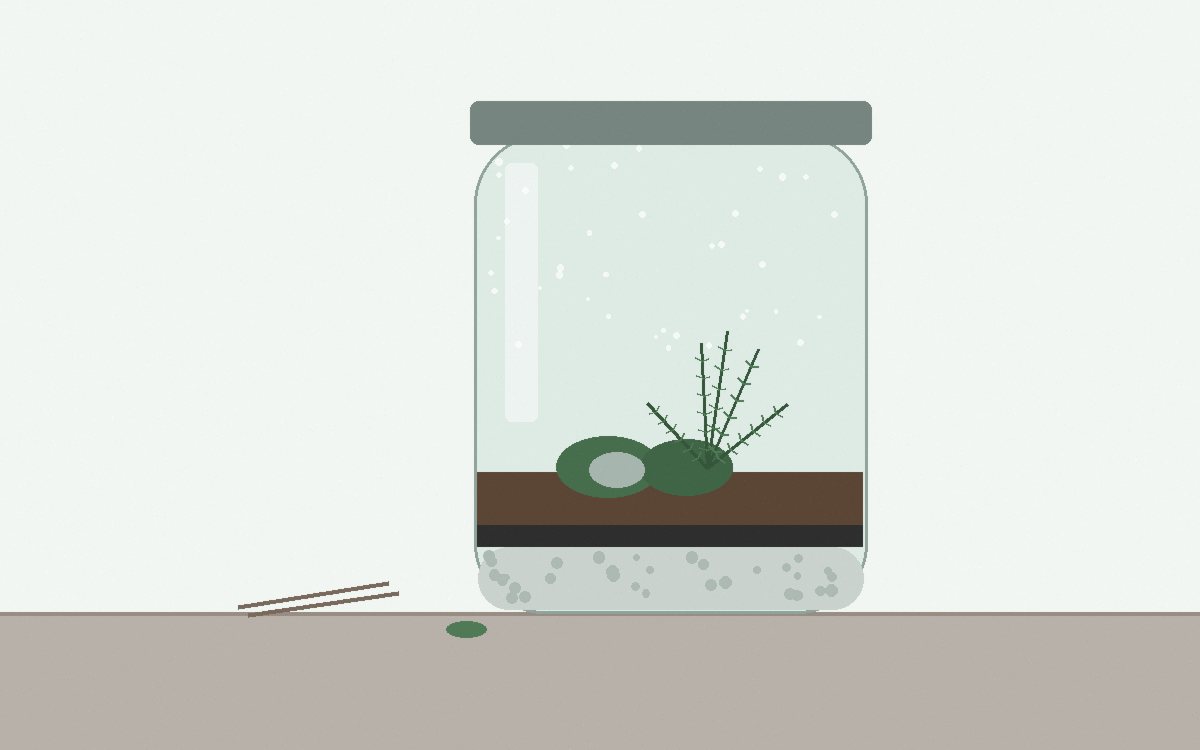
Planting day is the only day in the jar's life that asks for real work — here is the order, and the drawer.
Planting day is an hour at the kitchen counter with a jar, four bowls of layers, a tray of quarantined plants, and tools from the cutlery drawer. It is fiddly, absorbing, and the only day in the jar's life that asks for real work. Done in the right order — layers, hardscape, tall plants, small plants, moss, mist, clean, lid — it goes smoothly. Done in the wrong order, you'll be lifting a fern back out to get a stone under it. Here's the order, and the drawer.
Tools from the kitchen
Two chopsticks (the whole toolkit for a narrow jar); a long spoon for moving substrate; a rolled sheet of paper as a funnel; a small mister or spray bottle set to the finest setting; a soft brush or a cotton bud for cleaning glass; tweezers if you have them, for moss and stones; and a clean cloth. That's it. Terrarium toolkits are sold and they're pleasant, but they are chopsticks with prices.
The order of planting
- Layers in, one at a time, tapped level with a chopstick between pours: gravel, barrier pressed flat, charcoal stripe, moistened substrate. Slope the substrate toward the back — the jar is a stage viewed from the front.
- Hardscape next. The stone, the bark, the little branch: place them now, pushed a third of the way into the substrate so they look settled, not dropped. Everything else arranges itself around them.
- The tall plant. Make a hole with a chopstick, lower the fern in by its root ball (chopsticks either side like tongs, or a spoon), firm the substrate round it with the chopstick, gently. Leaves shouldn't touch glass — they'll rot where they press.
- The middle plants, spaced apart, each pinched back a third. Half density; resist filling gaps.
- Moss last, pressed onto the substrate between everything, gaps left for stone and soil to show. Sheet moss can drape the front edge; cushion moss sits in the middle ground like hills.
Mist, don't pour. The substrate went in damp, so the jar needs only a fine misting — twenty to thirty sprays across the plants and moss in a big jar, less in a small one — to settle everything and start the cycle. If water pools visibly in the gravel deeper than a centimetre, you've overdone it; leave the lid off a day. The single most common first-week disaster is "watering in" a new jar with a cup, which drowns the reservoir and takes a fortnight of lid-off drying to fix.
Cleaning the glass
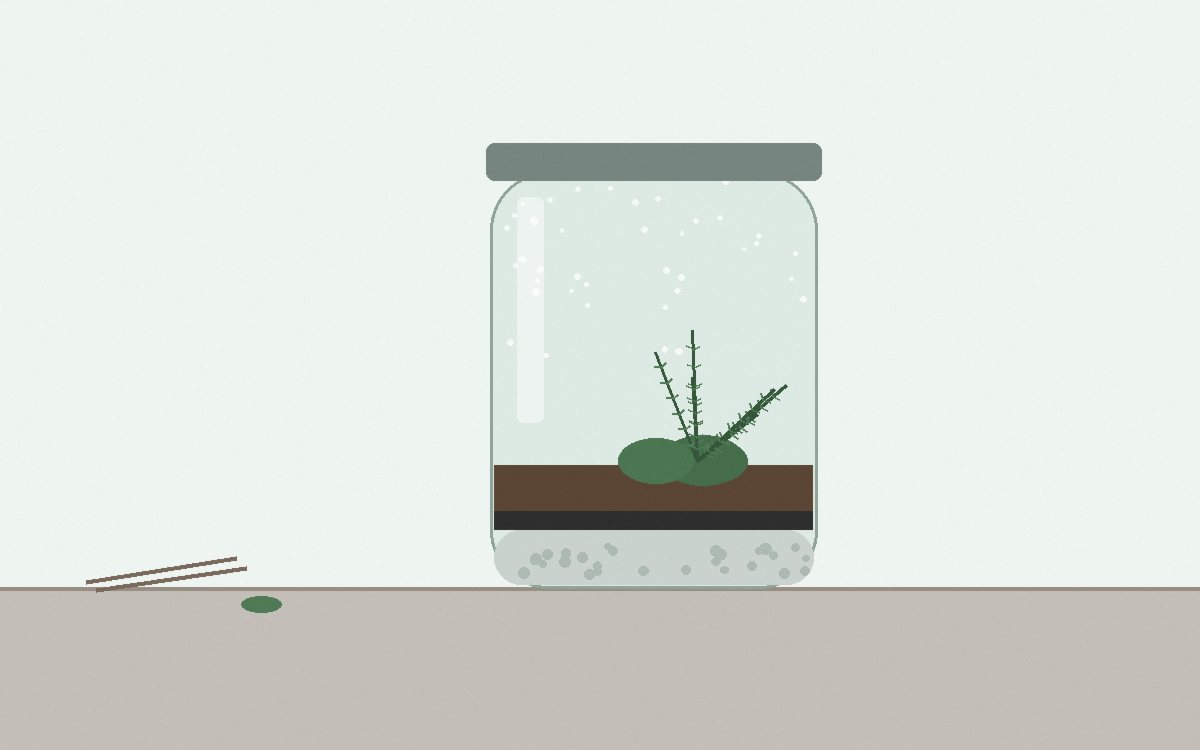
Before the lid, clean the inside of the glass above the soil line: soil smears and stuck moss on the glass become the first fuzz. A cotton bud, a soft brush, or a cloth wrapped on a chopstick, working in circles from the top down. Then clean the outside, because you're about to look at this jar every day. Ten minutes of cleaning on planting day saves weeks of squinting through streaks.
The first closing
Lid on, jar placed in its bright-indirect spot (Jar 06), and the first observation begins. Within a day you should see light fog on the upper glass in the morning that clears by early afternoon. That's the cycle running. No fog at all after two days: mist a little more. Fog all day and running streams: crack the lid for a few hours. Jar 05 goes deep on reading it. For the first two weeks, don't touch anything beyond the lid — plants are settling, moss is deciding, and every poke sets them back.
Narrow-necked bottles
The same order, with everything through a funnel and two chopsticks, and the plants dropped in rootball-first with a chopstick to guide them upright. It takes three times as long and it's genuinely satisfying, like ship-in-a-bottle for gardeners. Do it on jar three, when the order is second nature.
Questions from the counter
Should I add springtails or isopods?
They're the "clean-up crew" that some jar-keepers add to eat mould and decay, and they work well — a culture from a terrarium shop, tipped in on planting day. They're optional in a well-built jar and a real help in a bottle you can't reach into. If the idea of tiny creatures under the lid doesn't appeal, skip it; the jar will manage.
How do I plant something the jar's mouth is too small to admit?
Divide it — most ferns and creepers split easily at the roots into pieces that fit — and plant the pieces, which is also better for the jar's density. Or choose a wider jar; the plant is not going to shrink.
I've got soil everywhere and a moss cushion upside down.
Standard planting day. Chopsticks flip the moss; a dry brush lifts soil off leaves; the glass gets its clean at the end regardless. Nothing done today can't be redone tomorrow, which is the great mercy of a jar over a garden.
Lid on — now learn what the fog is saying: reading the fog.