The five layers
Published Sep 1, 2026 · 7 min read
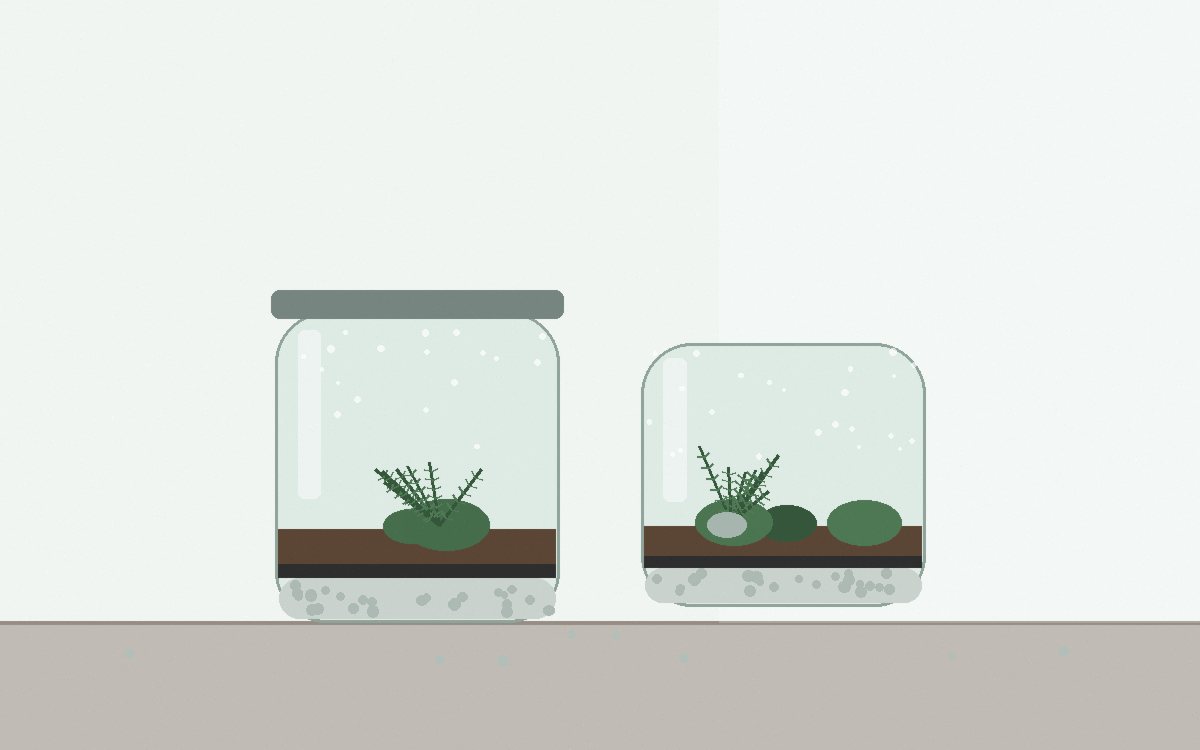
A jar without layers is a pot with a lid — and it will sour, sog and smell within weeks.
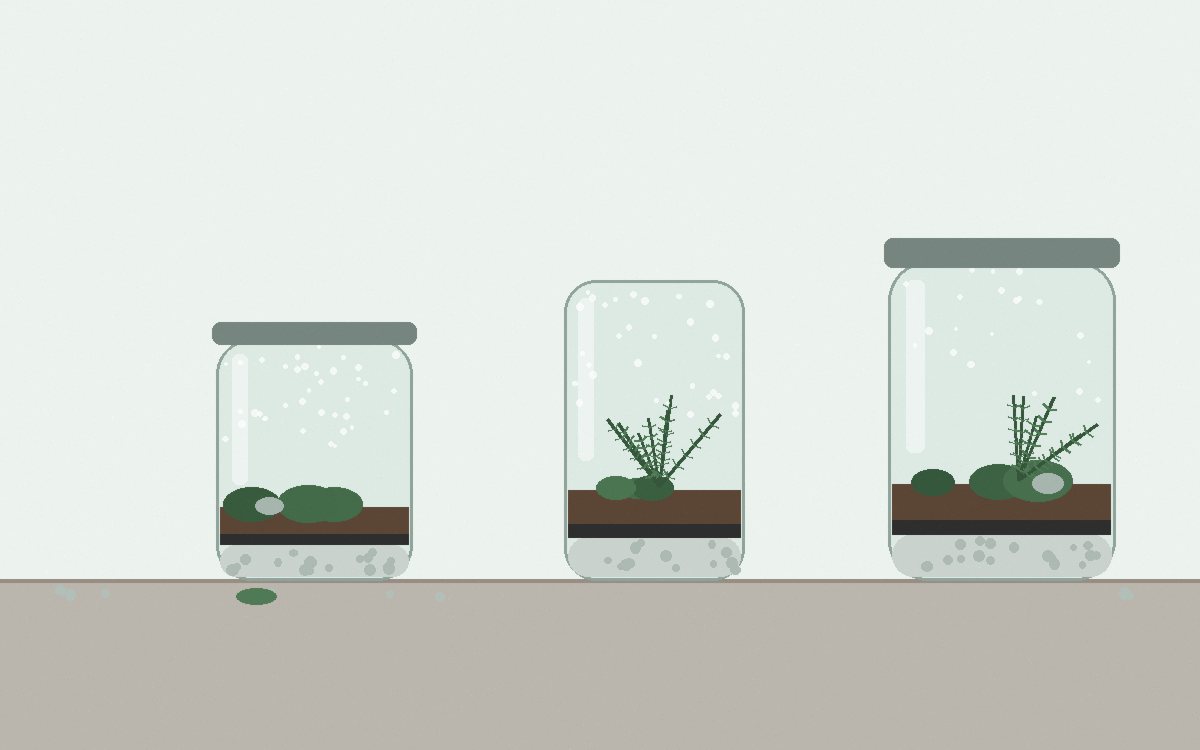
Open up any thriving closed terrarium and you'll find the same stratigraphy: a stony bottom, something to keep soil from washing into it, a dark line of charcoal, then soil, then the green. Five layers, each doing a job the others can't. A jar without them isn't a terrarium, it's a pot with a lid — and it will sour, sog and smell within weeks. Here's each layer, why it's there, how deep, and the one you can honestly skip.
Layer one: drainage (the false floor)
A sealed jar has no drainage hole, so it needs somewhere for excess water to sit that isn't the roots. That's the gravel: aquarium gravel, small pebbles, clay balls, crushed brick — anything inert, rinsed, and roughly pea-sized. Depth: about a fifth of the jar's height, or three to four centimetres in a big pickle jar. This reservoir is where the water cycle stores its surplus; you'll see a shine of water in it after misting, and that shine is the jar's gauge (Jar 05). Too thin and roots drown; absurdly thick and you've wasted planting space. A fifth is right.
Layer two: the barrier
Soil poured straight onto gravel migrates down into it and clogs the reservoir within a month. A barrier stops that: a circle of fine mesh (window screen, a piece of tights, a coffee filter, a layer of sphagnum moss) cut to sit on the gravel. It's the layer beginners skip, and the one whose absence shows up as muddy gravel and a sour smell in week six. Cut it a little oversized so it curls up the glass a centimetre.
Layer three: charcoal, the one you may skip. Activated charcoal (the aquarium or horticultural kind, not barbecue briquettes) is traditionally scattered as a thin dark line on the barrier to absorb odours and slow the funk of decay in a sealed box. It helps. It's also the layer whose absence matters least: a jar built well with the other four and not overwatered stays sweet without it. If the shop has it, add a thin line — half a centimetre — because it looks handsome as a stripe. If it doesn't, build without and open the lid for an hour a week for the first month.
Layer four: the substrate
Not garden soil (too heavy, full of passengers) and not pure potting compost (too rich, feeds mould). The mix that works: two parts ordinary peat-free potting compost, one part fine orchid bark or coco chips for air, one part sand or fine grit for drainage, and a handful of the sphagnum from the barrier if any is left. Moisten it before it goes in — damp enough to clump, not to drip — because trying to water dry soil inside a jar makes mud on one side and dust on the other. Depth: enough for the plants' roots plus a couple of centimetres; another fifth of the jar is typical. Slope it slightly, higher at the back, so the view has depth.
Layer five: the garden
Plants and moss, plus the hardscape — a stone, a piece of driftwood, a shard of bark — that makes a jar a landscape rather than a salad. The rule of the fifth layer is less than you think: a jar planted at half density looks bare on day one and perfect at month two, because everything in it grows. Jar 03 chooses the plants; Jar 04 puts them in.
Proportions at a glance
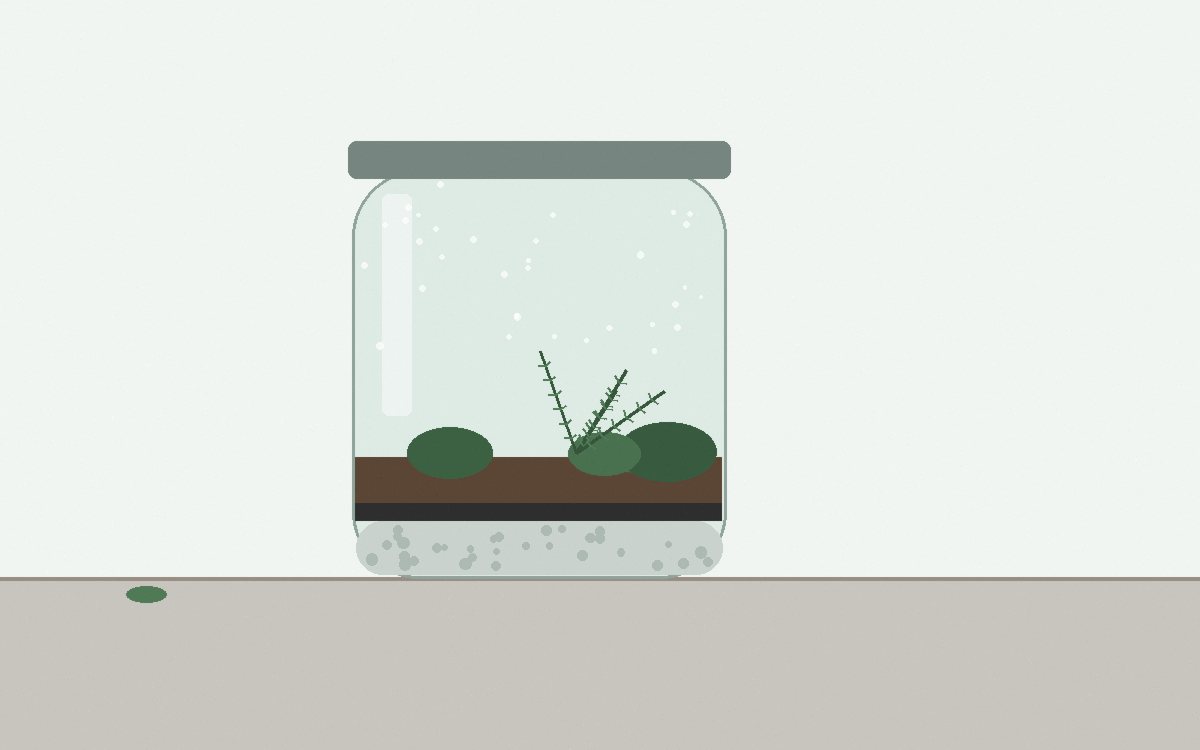
- Gravel: 1/5 of the height. Barrier: paper-thin. Charcoal: a stripe.
- Substrate: 1/5, sloped. Plants and hardscape: the remaining 3/5 is air and view — keep it.
- Total soil-and-stone below the plants: about two-fifths of the jar. If it's more, you've built a bucket, not a garden.
Questions from the workbench
Do I need to sterilise the gravel and soil?
Rinse the gravel until the water runs clear; that's enough. Soil from a fresh bag is fine as it is. Baking soil to sterilise it is sometimes recommended and mostly pointless — it kills the useful life along with the rest, and a jar builds its own tiny ecosystem within weeks regardless. Clean, not sterile.
Can I use leca (clay balls) for the whole bottom?
Yes — leca is light, inert and wicks well, and it's our favourite drainage in big jars where gravel gets heavy. Rinse it, and use the barrier above it as usual; soil moves into leca gaps just as readily.
My jar is a bottle with a tiny neck. How do I get layers in?
A funnel from a rolled magazine or a sheet of paper, one layer at a time, tapped level with a chopstick between pours. Bottles are the advanced version of the hobby — they're beautiful, slow and fiddly. If this is the first jar, do a wide one first and keep the bottle for jar three.
Foundation laid — now the residents: plants for the jar.